> For the complete documentation index, see [llms.txt](https://docs.fenixpyre.com/llms.txt). Markdown versions of documentation pages are available by appending `.md` to page URLs; this page is available as [Markdown](https://docs.fenixpyre.com/fenixpyre-for-users/windows-agent/how-to-share-a-file-using-fenixpyre.md).
# How to share a file using FenixPyre
FenixPyre offers two secure file sharing methods: **Right-Click Share** and **Outlook Share**, both utilizing encryption for protection.
### Right-Click Share (Secure)
{% stepper %}
{% step %}
### Select the files
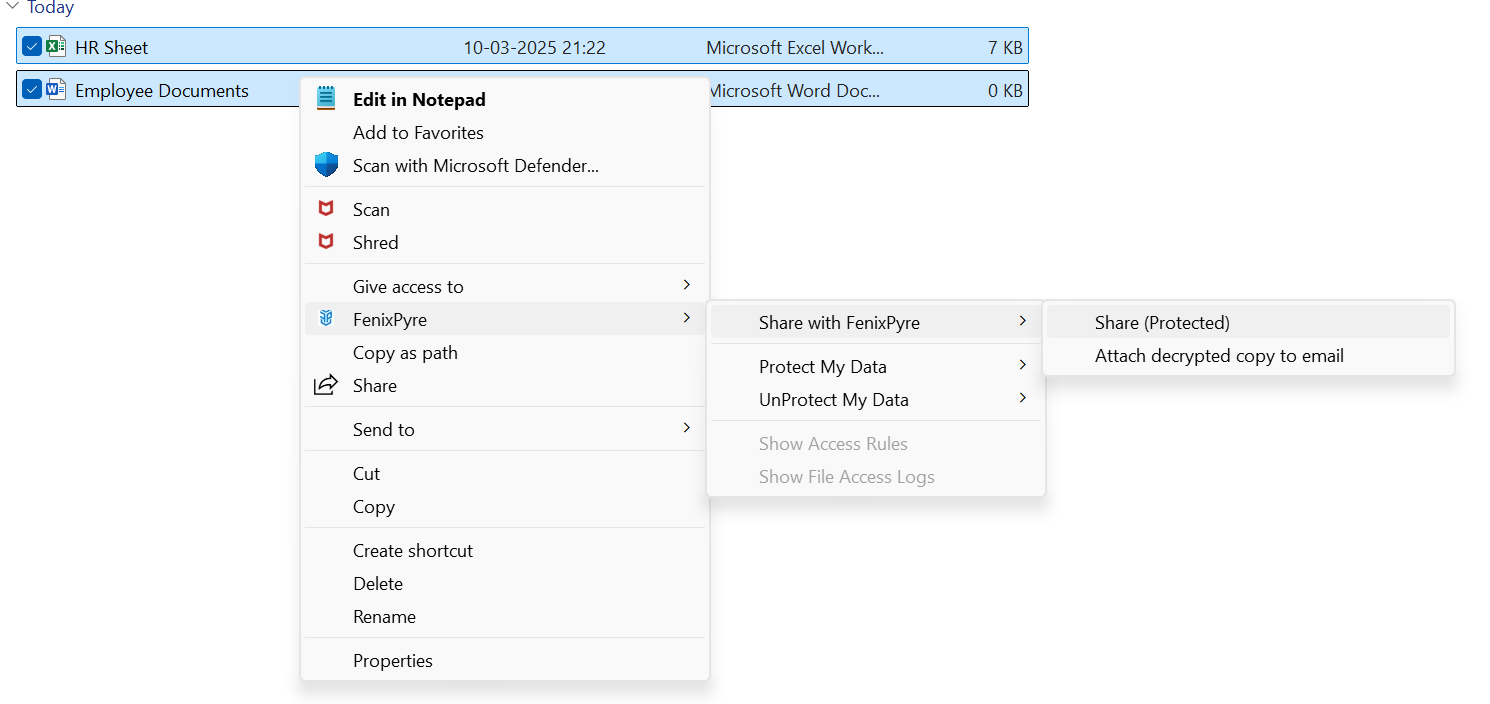
Select the files you want to share and right-click > **FenixPyre > Share with FenixPyre > Share (Protected).**
{% hint style="info" %}
Note: You can share multiple files or a single folder at a time, but there is a limit. Currently, the maximum number of files that can be shared is set to 50.
{% endhint %}
{% endstep %}
{% step %}
### Configure share settings
**Add Files:** Click on "Add Files" to open File Explorer and select more
**Remove Files:** To remove files and prevent sharing, check the file's box and click "Remove File."
**Link Name:** Choose a link name to identify this link.
**Link Permission:** Grant VIEW or EDIT access to recipients as needed
**User email(s)**: Provide email addresses for file sharing.
You can also set an expiry date for the shared link, with a default of 60 days.
**Allow Unprotected Download**: By selecting this option, your shared content will be delivered securely. Once received, the recipient can download the content as a decrypted file
{% endstep %}
{% step %}
### Share the link
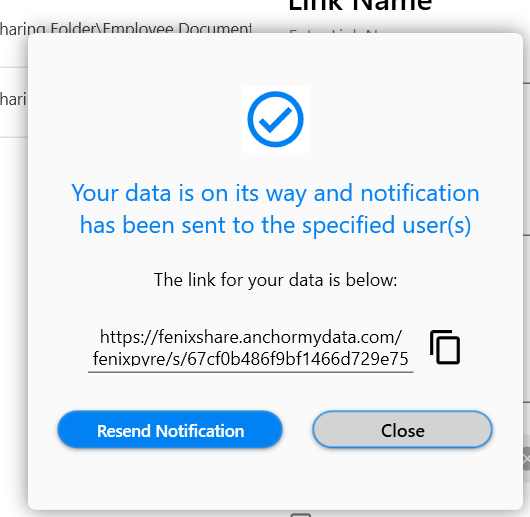
Once you click on share files, the files will get uploaded to FenixPyre Sharing and a notification will be sent to the recipients with the shared link.
{% endstep %}
{% endstepper %}
You can manage your shared files from [FenixPyre Sharing Portal](https://fenixshare.anchormydata.com).
**Notes:**
* Unsupported file extensions cannot be shared. If a user attempts to upload a file with an unsupported extension, they will receive the following
* All file extensions which are are added to the Authorized file extensions tab in the Admin Dashboard may be shared. However, when sharing in a view-only format only certain file types can be viewed in your browser which include the following:
`pdf,txt,doc,docx,ppt,pptx,xls,xlsx,png,jpeg,jpg,mp4,xps,xml,htm,html,rtf,mhtml,csv,xlsm,xlsb,gif`
* User is allowed to share files from the Protected as well as Non-Protected directory.
* User is allowed to share encrypted files as well as decrypted files as long as the decrypted files are successfully encrypted before sharing.
---
# Agent Instructions
This documentation is published with GitBook. GitBook is the documentation platform designed so that both humans and AI agents can read, navigate, and reason over technical content effectively. Learn more at gitbook.com.
## Querying This Documentation
If you need additional information that is not directly available in this page, you can query the documentation dynamically by asking a question.
Perform an HTTP GET request on the current page URL with the `ask` query parameter, and the optional `goal` query parameter:
```
GET https://docs.fenixpyre.com/fenixpyre-for-users/windows-agent/how-to-share-a-file-using-fenixpyre.md?ask=&goal=
```
`ask` is the immediate question: it should be specific, self-contained, and written in natural language.
`goal` is optional and describes the broader end goal you are ultimately trying to accomplish on behalf of the user. GitBook uses it to tailor the answer towards what is most useful for that goal.
The response will contain a direct answer to the question and relevant excerpts and sources from the documentation.
Use this mechanism when the answer is not explicitly present in the current page, you need clarification or additional context, or you want to retrieve related documentation sections.